
Two Women Lead $12B BART Extension as Construction Nears Tunnel Launch
By Elizabeth Nguyen
Silicon Valley Business Journal
Thursday, March 12, 2026
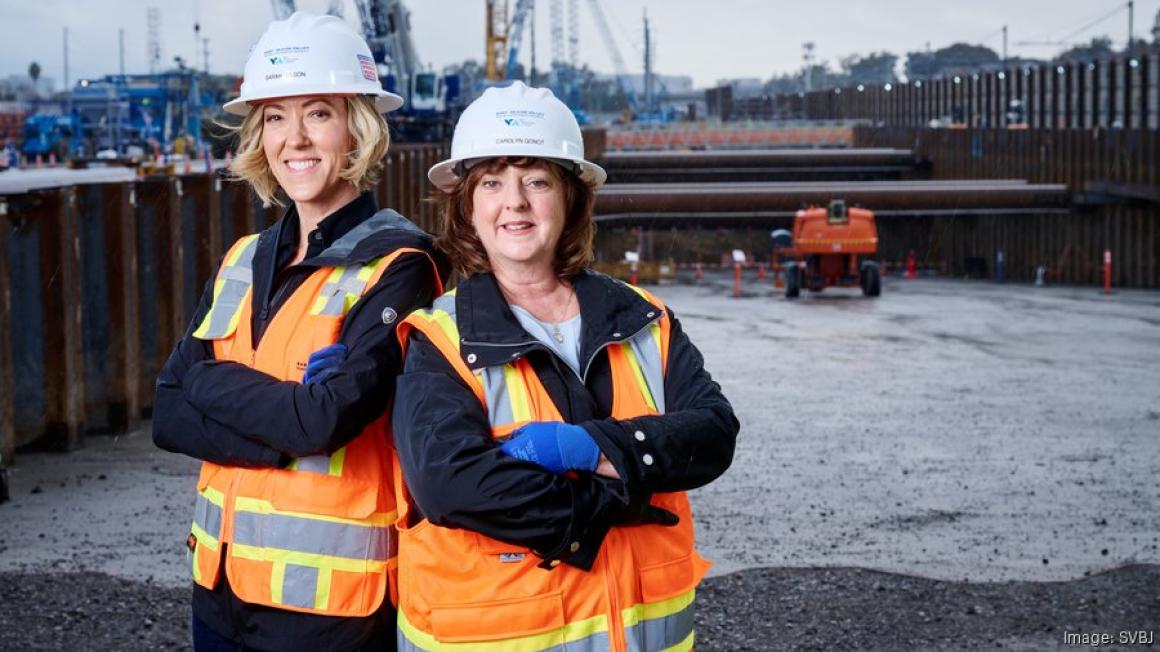
At a construction site near Santa Clara Station, two women are overseeing crews building a launch structure that will help extend BART through downtown San Jose.
The roughly $400 million structure is part of the $12 billion Silicon Valley Phase II extension.
At a construction site near Santa Clara Station, two women are overseeing crews building a launch structure that will help extend BART through downtown San Jose.
The roughly $400 million structure is part of the $12 billion Silicon Valley Phase II extension.
Sarah Wilson, construction director for the project at the Santa Clara Valley Transportation Authority (VTA), oversees field delivery, contract administration and risk allocation.
Carolyn Gonot, the agency’s general manager and CEO, is responsible for funding, governance and federal oversight that keep the project on track.
The six-mile extension will add four stations, including three underground, and connect downtown San Jose and Santa Clara to the broader Bay Area Rapid Transit network, according to VTA. The project carries an estimated budget between $12.1 billion and $12.7 billion.
Wilson’s responsibilities center on execution. At the West Portal site, crews are building a shaft-and-ramp structure that will allow trains to transition underground after exiting Santa Clara Station and will serve as the launch point for the tunnel boring machine.
“That structure will serve in the future during revenue service for trains to go underground after they exit Santa Clara Station,” Wilson said. “In the meantime, we are going to use it to build that tunnel to launch our tunnel boring machine.”
The project is being delivered through multiple contract packages, including progressive design-build, where the contractor also holds the design contract. Traditionally those phases are handled by separate companies. This model changes oversight responsibilities compared with traditional design-bid-build delivery.
“We manage them differently than we would if it was a design-bid-build project,” she said.
Wilson said the project follows federal risk management protocols, including matrices that assign probabilities and impacts to potential issues.
“A basic principle of risk is that the party best able to manage the risk is the one that is assigned to that risk,” Wilson said.
She said collaboration reduces the likelihood of disputes.
“The best thing you can do to manage risk is more collaboration,” she said. “Decide together very openly who owns what so that when an issue comes up, it’s really easy to address rather than spending the time arguing over whose risk it is.”
Wilson began her career in design, working on tunnels and underground structures before moving into field operations. She said a small tunnel project across the Hayward Fault shifted her focus from design review to construction decision-making.
“It just opened up a whole world to me,” she said.
Field work required immediate judgment calls.
“In construction, the best decision is one that has been made,” Wilson said. “The concrete trucks are coming. Can they pour or can they not pour? It’s a yes or no.”
Looking ahead, she said construction of station entrances, known as adits, will present technical challenges due to soil conditions. Ground improvement techniques such as grout injection or soil freezing may be required to stabilize the soil before excavation.
“The adits are going to be very, very technically challenging because the ground is not beautiful ground for the type of construction that we’re planning to use,” she said.
At peak, the program involves roughly 325 VTA staff and consultants and about 175 contractors and subcontractors, requiring coordination across contractors, board members and other stakeholders.
“We’re balancing stakeholder desires and we’re reporting to our board and we’re making sure that all of our stakeholders feel comfortable that we’ve investigated all the different ways to execute the project,” she said. “All while trying to keep the project moving forward.”
While Wilson focuses on field execution, Gonot’s role centers on governance and funding.
“At this stage in Phase II, my top priority is to keep the project on the critical path and receive full funding so that the project stays on schedule,” Gonot said.
The extension relies heavily on federal support through the Federal Transit Administration Capital Investment Grant program, according to VTA. Maintaining compliance with federal requirements and reporting obligations is necessary to preserve that funding, Gonot said.
Oversight includes monitoring schedule performance, risk exposure and expenditures.
“I look at the major risks, the schedule, the critical path for the schedule and where we are on the costs and our expenditures,” Gonot said.
In addition to overseeing the capital program, she manages countywide transit operations including ridership levels, on-time performance and operating costs.
“It’s a combination of really focusing on making sure that our service is out there on the streets when our customers need it and that the project is moving forward on the path that we anticipated to be on,” she said.
Gonot previously served as a chief officer during Phase I of the extension, according to VTA. “It’s definitely a transition from the day-to-day management of a project to providing more oversight and strategic guidance,” she said.
She said accountability includes ensuring the agency has the technical capacity to deliver the project while managing cost, schedule and scope. It also includes responsibility “to the voters and to the citizens of this county,” she said.
The extension is expected to improve regional connectivity and economic integration across Silicon Valley and the broader Bay Area, according to VTA planning documents.
Current market conditions add pressure to large capital projects. Wilson described the construction environment as competitive, with sustained demand and elevated pricing. Gonot emphasized cost discipline and funding certainty as continuing priorities.
“There are a lot of smart people here,” Wilson said. “I really think we’re going to be able to get that done.”